Research
Particle-in-Cell for Efficient Swell — PiCLES

PiCLES is an efficient wave model for air-sea coupling in Earth System Models. It uses particle-based Lagrangian modeling with periodic remeshing to estimate swell in coupled Earth system models at a fraction of traditional computational cost.
Surface Waves Govern Air-Sea Exchange
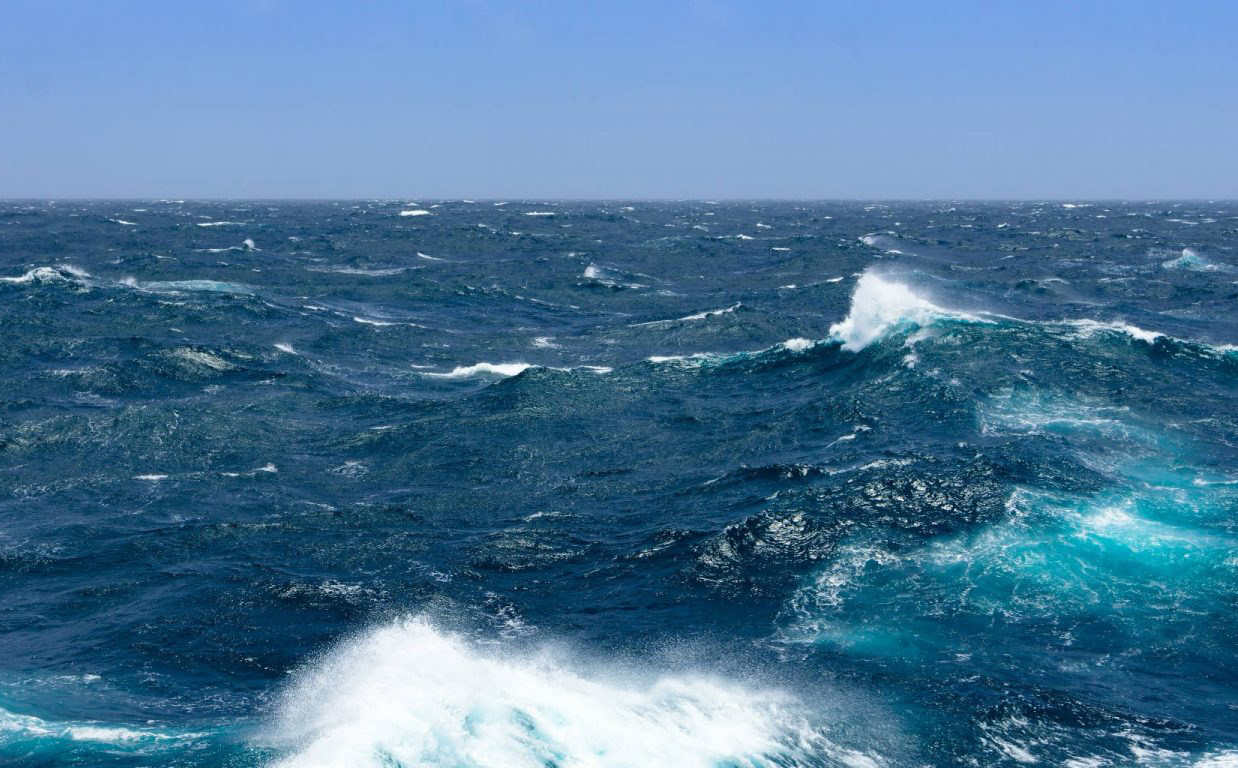
The sea state controls momentum transfer across the air-sea boundary and alters surface stress, fluxes of CO₂, and heat between the atmosphere and the ocean. I focus on how synoptic-scale variability influences air-sea exchange through waves or upper ocean turbulence. I combine simple models of surface wave generation with optimization methods to apply them to ensembles of wave observations.
Swell Generation under Extra-Tropical Storms
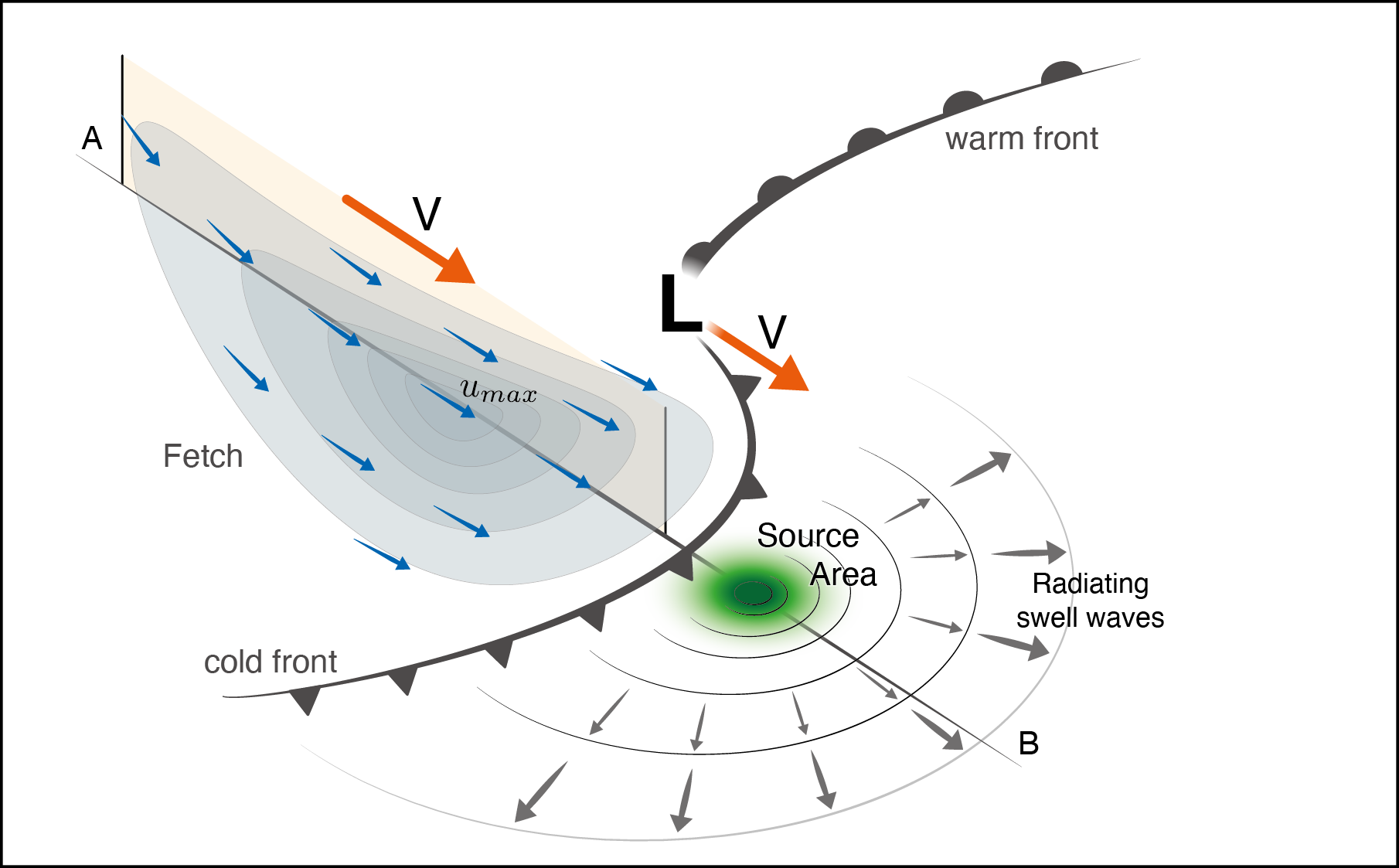
Storms generate swell events that many like to surf. I study how the dynamics of the storm determine the generated swell using idealized models, observations from wave buoys, remote sensing data, and non-linear optimization methods.
The key mechanism is the trapping of wave energy under the moving storm. While short wave energy is left behind, longer waves keep up with the storm and are further amplified, compressing energy into a small localized swell source in the open ocean. Stronger, faster-moving storms generate larger swell events, while storms that propagate too fast are less efficient.
Waves in Sea Ice
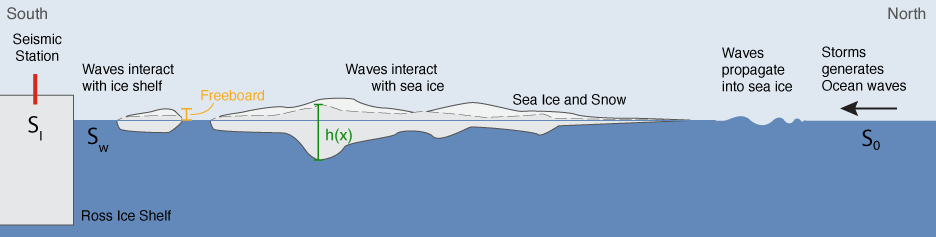
Waves can break up, disperse, or drift sea ice and alter air-sea heat fluxes, playing a major role in globally retreating sea ice. I use satellite and in situ observations to understand how surface waves behave in sea ice, with a focus on the Marginal Ice Zone (MIZ). Waves in the MIZ are a dominant source of mechanical breaking of sea ice with potentially enormous consequences for air-sea exchange in that region.
Surface Winds
Surface winds play a key role in air-sea coupling — forcing the ocean on synoptic scales while also responding to sea surface temperature patterns and ocean currents. My research focuses on statistical representation of surface winds over the ocean. Using remote sensing products, reanalysis data, and state-of-the-art high-resolution models, I derive wind statistics that vary in space and time. The shape of the wind probability density function is non-Gaussian and can be expressed as a superposition of empirical modes.
The leading modes of the surface wind PDF are connected to large-scale atmospheric drivers. For example, mid-latitude wind statistics are driven by the momentum balance of the atmospheric column aloft, providing insight into how surface wind statistics and subsequent air-sea fluxes may change under warming.